
Growth Creates Complexity. Customer Experience reveals it First

Updated: Apr 30
Growth is usually celebrated in business.
New markets, expanding product portfolios and increasing demand all signal progress.
But in complex product organisations whether vehicles, engines, industrial equipment, power systems or advanced technologies, growth naturally brings a new challenge:
Complexity.
This isn’t a failure of the business. It’s a natural outcome of success.
The key is recognising how that complexity shows up and using it to guide better decisions; the earliest signals rarely appear in financial results.
They usually appear first in customer interactions, service performance and operational friction.
The Early Signals
In complex product environments, the relationship with the customer does not end at the point of design or sale.
It continues through installation, operation, support, maintenance and ongoing use.
This is where organisations learn how well they are really performing.
As complexity increases, subtle shifts begin to appear:
Customers engage less frequently outside of service events
Service teams begin carrying a greater share of operational load
Cost-to-serve increases across support functions
Internal coordination between sales, service and operations becomes more difficult
Customer interactions become more transactional
Individually these signals may not seem significant.
But together they provide valuable insight into how the organisation is evolving.
Where Complexity Becomes Visible
In many organisations, performance is still primarily measured through sales and financial outcomes, but these metrics often lag behind what is happening operationally.
The reality is that complexity becomes visible much earlier in how the organisation performs across the customer lifecycle.
It shows up in:
How easily customers can engage
How effectively issues are resolved
How consistently service is delivered
How well internal teams coordinate around the customer
This is where the organisation’s structure is truly tested.
Not in strategy documents or sales pipelines but in day-to-day customer experience.

The Commercial Impact of Hidden Complexity
One of the challenges with organisational complexity is that its commercial impact is often delayed.
Revenue may continue to grow. Sales pipelines remain active. New opportunities continue to emerge - but underneath, the nature of customer relationships begins to shift.
Customers engage less frequently outside of reactive events. Repeat business becomes less predictable. Interactions are driven more by need than by value.
In many cases, customers return primarily when something goes wrong, through service events, warranty issues or operational failures.
While this can sustain short-term revenue, it often highlights an opportunity:
The organisation is not yet fully capturing value across the customer lifecycle.
Over time, this can lead to:
reduced repeat business
increased reliance on reactive service and warranty activity
higher cost-to-serve
lower customer loyalty
greater exposure to competitive switching
Recognised early, these patterns can be addressed before they impact long-term performance.
Why These Signals Are Often Misunderstood
These changes are often interpreted as operational issues.
Service teams need more resources. Customer engagement needs improvement. Processes need refinement.
While these responses may help in the short term, they rarely address the underlying cause.
In many cases, the business has simply grown faster than the operating model around it.
Product strategy, service capability, commercial incentives and customer lifecycle management are no longer fully aligned with the scale and complexity of the organisation.
Customer Experience as Strategic Intelligence
Customer experience is often discussed as a service metric but in complex product businesses it plays a much more strategic role.
Customer interactions provide a continuous stream of insight into how the organisation is functioning.
They highlight:
where friction exists between teams
where processes are breaking down
where expectations are not being met
where complexity is beginning to outpace capability
These signals are not just problems to fix.
They are valuable indicators of where the organisation needs to evolve next.
Viewed this way, customer experience becomes strategic intelligence for leadership teams, not simply a measure of satisfaction.
Interpreting Complexity
Navigating growth successfully requires more than increasing capacity.
It requires recognising when structural alignment needs to evolve.
Leadership teams need to ask:
Is the service model aligned with the scale of the business?
Are commercial incentives supporting long-term customer value or short-term sales?
Are product, service and operational teams aligned around the customer lifecycle?
Are customer signals being interpreted operationally or strategically?
These are leadership questions and they create the foundation for stronger, more resilient performance.
Turning Signals Into Sustainable Growth
Most organisations already have the information they need.
Customer feedback, service data and operational indicators exist across the business.
The opportunity lies in interpreting those signals clearly and using them to guide alignment across strategy, operations and customer engagement.
Because in complex product businesses, growth does not need to be constrained by complexity.
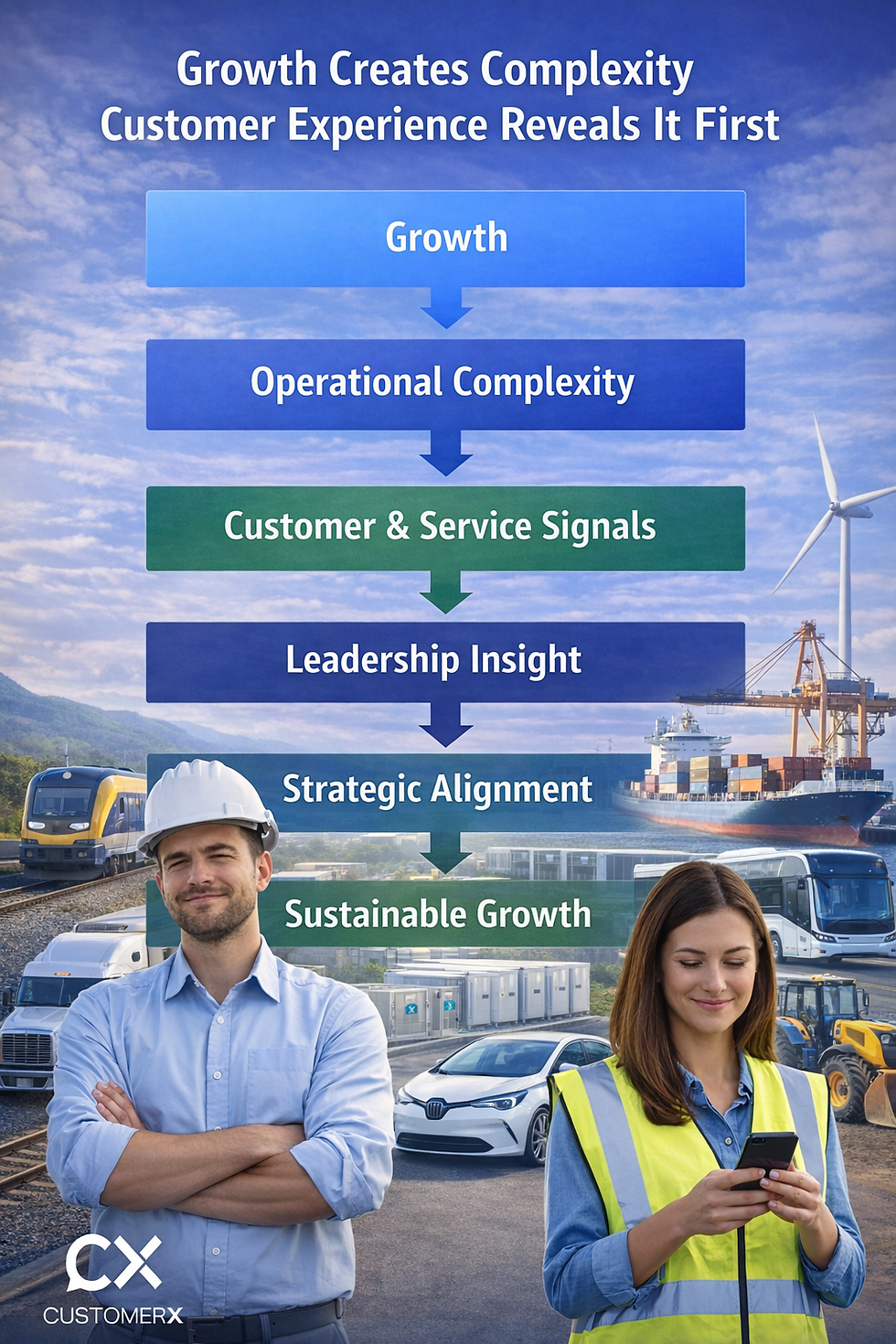
When organisations recognise where strain is emerging and respond early, they can:
strengthen performance
improve customer relationships
increase repeat business
reduce cost-to-serve
build more resilient, sustainable growth
Sales creates growth.
The customer lifecycle determines whether it is sustained and scaled.
If these patterns sound familiar, they’re often a sign of growth, not failure.
The organisations that perform best are those that recognise these signals early and use them to strengthen alignment across the business.
If you’re exploring how this applies in your organisation, please contact us, it would be great to get your perspective.


Comments